Yes No Share to Facebook
Landlord's Ledger:
A Vital Document to Establish Rent Arrears at an LTB Hearing
Last Updated: August 22 2026
Question: What records and proof do I need to prepare a landlord ledger for an Ontario Landlord and Tenant Board hearing?
Answer: For an Ontario Landlord and Tenant Board hearing, you should prepare a clear landlord ledger showing each rent/fee payment: the rent amount, what was actually received, the payment date, the payment purpose, and a running total of any arrears, backed by supporting documents like bank statements, receipts, cancelled cheques, lease, relevant emails, and any NSF charges you actually paid Keep one simple ledger per rental unit, use one line per payment, and match the ledger entries to your bank statements to avoid gaps or contradictions that can weaken the claim If you need help organizing the ledger and attachments so the Adjudicator can quickly follow the money trail, Cross Legal Services can assist across Ontario, call (289) 443-0675.
Add this website to Google Preferred Sources
Landlord's Records & Supporting Documentation

Note: Please contact Cross Legal Services by phone at: (289) 443-0675 to discuss any specific questions that you may have.
This is an accounting document that you will need to provide prior to the filing of an application or the service of a notice as this is the information that the notices and applications are based on. Inaccurate and partial accounting information may result in an application being dismissed.
Part 1: Understanding the Landlord's Ledger
1. The designated rent amount,
2. The actual payment amount received,
3. Date of payment,
4. The purpose of the payment, such as rent, fees, or deposits, and
5. A running total indicating any unpaid sums.
Maintaining Accurate Records
Keep it Simple
Identifying Discrepancies
Here are some tips to effectively manage your rental ledger:
- . Periodically cross-reference bank statements and receipts with the ledger.
- . Document any changes in the rent amount in accordance with lease agreements.
- Verify tenant details to ensure consistency with lease agreements and payment records.
- . Enter only one item per line in the table, do not ‘stack’ multiple items or numbers all on one row.
- . Do not ‘pool’ or combine values. Keep one ledger per rental unit and use one line per payment if there are multiple payments from multiple tenants per rental unit. You will need to match the payments in your ledger to your bank statements.
Part 2: Supporting Documentation
Proving non-payment of rent can be challenging since it's difficult to provide documentation for something that didn't occur. However, the landlord's ledger effectively establishes payment history, shedding light on payments made and missed. Once arrears are established, the responsibility shifts to the tenant to provide evidence of payment.
Essential Documentation Includes:
- . Bank statements,
- . Payment receipts,
- . Copies of cheques or canceled cheques,
- . Correspondence, such as emails and communications regarding unpaid rent,
- . The executed lease agreement,
- . Any NSF charges actually paid, and
- . Any additional documentation supporting the claim of non-payment.
Important Note:
Example Landlord's Ledger:
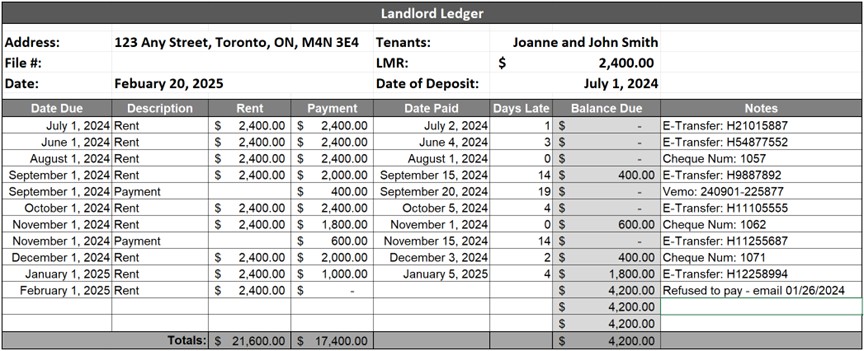
Please call or email with any questions or to request an Excel Template.
NOTE: A significant quantity of online searches featuring “lawyers near me” or “best lawyer in” typically indicates an urgent requirement for competent legal assistance rather than a particular designation. In Ontario, licensed paralegals are governed by the same Law Society that regulates lawyers and possess the authority to represent clients in specified litigation matters. Advocacy, legal analysis, and procedural proficiencies are integral to this function. Cross Legal Services provides legal representation within its licensed parameters, focusing on strategic positioning, evidence preparation, and compelling advocacy aimed at securing effective and beneficial outcomes for clients.